Virtually every major organization uses SSH keys alongside passwords. They offer a secure way of granting access and controlling who has access to critical systems and infrastructures. SSH stands for ‘Secure Shell’, a cryptographic network protocol that enables secure access, remote control and administration and encrypted data transfer between clients and servers.
Solid security measure or biggest blind spot?
Introduced in 1995, SSH has proven itself over all this time. Its encryption provides a significant security improvement over plaintext authentication methods like classic passwords. In many scenarios offering a stronger alternative. But this is only true when SSH keys are properly managed. SSH keys can only be considered safe when they are controlled and regularly reviewed. Otherwise, they quickly go from security controls to potential entry points.
The biggest advantage of these keys is also their biggest risk. They are permanent by default and remain valid until they are explicitly removed. Once a user account has an authorized key, they retain access until someone revokes it.
Convenience, control, and catastrophe
The decentralized management of keys is one of the biggest challenges modern organizations face. From an operational perspective, access should be granted almost instantly upon request. Making sure employees, administrators and external partners can do their job without unnecessary hassle or delay.
A lot of organizations rely on ticketing systems or even simply email requests for access. Often, automated workflows validate requests against predefined policies. If everything checks out, a key is generated and distributed within minutes. While this makes access management efficient, organizations end up accumulating thousands of active SSH keys over time.
A hidden vulnerability in your infrastructure
The real danger hides in the correct management. How do you keep track of every active key in your environment? How often are keys verified to see if they’re still needed?
Think external parties who required temporary access for a one-time-implementation. Think consultants moving between project phases, needing different levels of access to systems and servers throughout the project timeline. Think internal employees switching roles, teams or leaving the company altogether.
An even greater risk exists with jump and management servers. Over time, they accumulate large numbers of SSH keys. If one of these servers is breached, attacker can leverage trusted keys to move laterally and access multiple systems across the environment.
Unfortunately, many organizations have little visibility into the SSH keys that exist across their infrastructure. The only insights they have rely on outdated Excel spreadsheets or incomplete documentation. This creates a major governance challenge. Visibility is lacking, periodic reviews rarely happen, and orphaned keys remain active for years.
As a result, one of the strongest security mechanisms in an organization can quietly become one of its largest hidden attack surfaces.
Introducing SSH certificates
Long-lived, standing credentials are being proven insufficient. In the field of cybersecurity there has been a huge shift in modern access management. Just-in-Time (JIT) credentials are becoming the new industry standard. This means permissions only exist when they’re needed in real-time.
The SSH principles still stand but instead of granting permanent access, there needs to be a set timeframe and lifecycle for these access rights. That’s where SSH certificates come into play. These secure measures have a defined lifetime and automatically expire after that set period. This renders them useless afterwards, reducing the risk of forgotten access remaining available after someone ends a project or leaves the company.
These certificates also allow additional time restrictions, such as specific maintenance windows or set to set working hours. Does a privileged management account really need access to the database server at 3:00AM every night? Probably not.
Making sure you don’t have excess access to critical infrastructures makes them less exposed to security risks.
We understand this additional security layer can feel restrictive for developers and system administrators who are used to having all access all the time. But with the right automation in place, requesting and receiving a certificate can also be very quick and effective. This fast and seamless extra step and improves the security posture significantly.
The key to security success
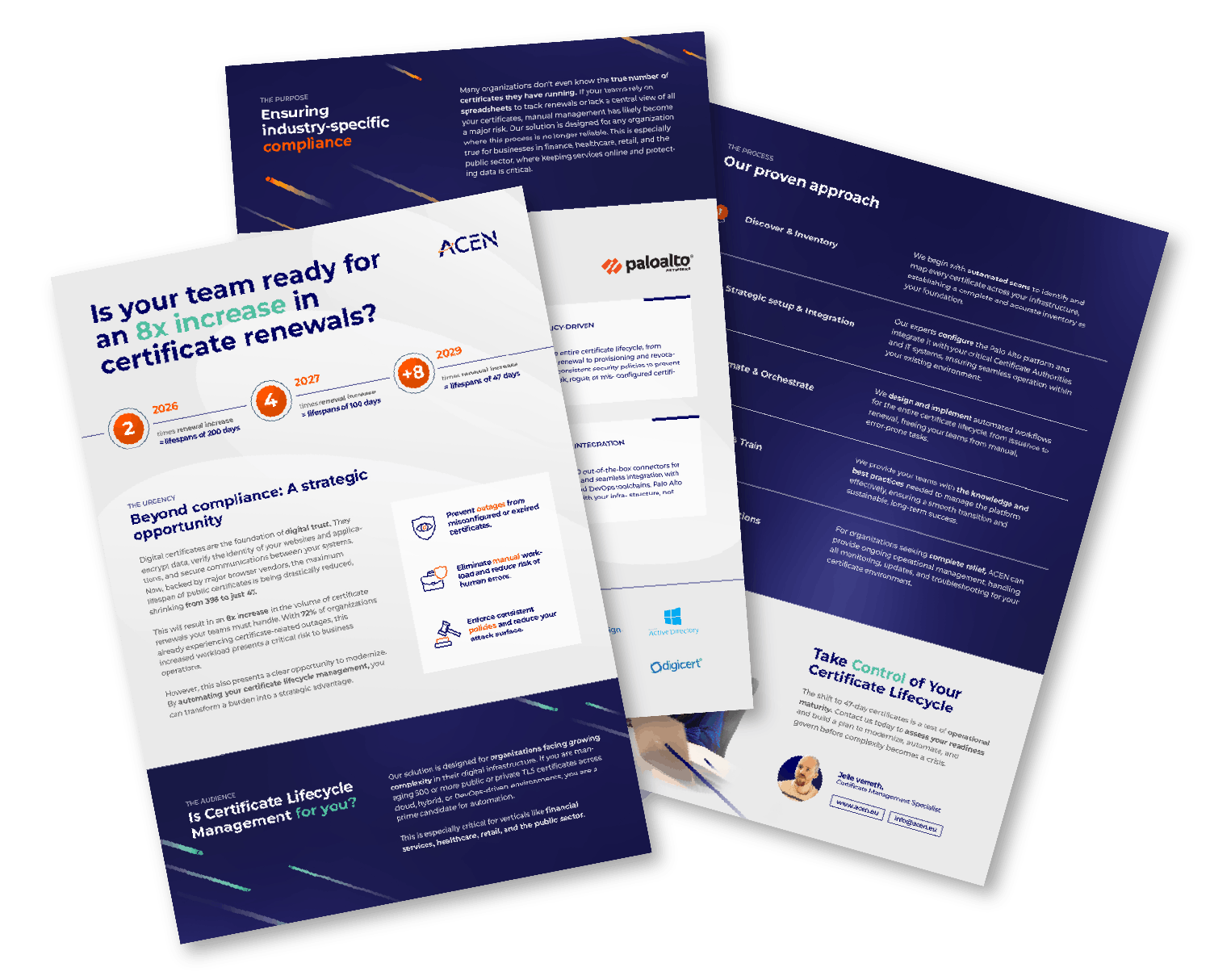
Through our CLM platform, built on the Palo Alto Networks framework, we provide complete certificate lifecycle management. You get all the benefits of SSH certificates without adding operational complexity. The platform also provides full lifecycle management of your SSH key inventory, ensuring complete visibility, governance, and auditability from creation to decommissioning.
Turn one of your biggest security risks into one of your strongest security assets. Discover how our Certificate Lifecycle Management solution can help you secure and simplify SSH access.