We’re proud to share that ACEN has been featured in De Tijd, one of Belgium’s leading business newspapers.
In an opinion article, William Rosenhek, Cyber Security Advisor at ACEN highlights a critical and timely topic: how traditional consensus-driven decision-making can leave organizations vulnerable to AI-powered cyberattacks.
Key insights from the article
- AI is accelerating attacks
Modern AI systems can identify vulnerabilities and execute attacks in milliseconds, while defensive processes often take weeks or months. - Decision-making is the real bottleneck
The biggest weakness in many organizations isn’t technical, it’s how decisions are made. Complex approval chains and internal alignment processes slow down response times significantly. - Attackers move faster than organizations
Unlike companies, attackers don’t rely on meetings, approvals, or internal politics. Their “teams” of AI agents act instantly. - Compliance ≠ security
Being compliant on paper doesn’t guarantee real-world readiness. Organizations may meet standards but still respond too slowly in practice. - AI can also be part of the solution
William suggests leveraging multiple independent AI systems to support faster, unbiased decision-making, effectively creating a “virtual steering committee” free from internal friction.
We want to thank William for this great insight, which we were allowed to share with the press.
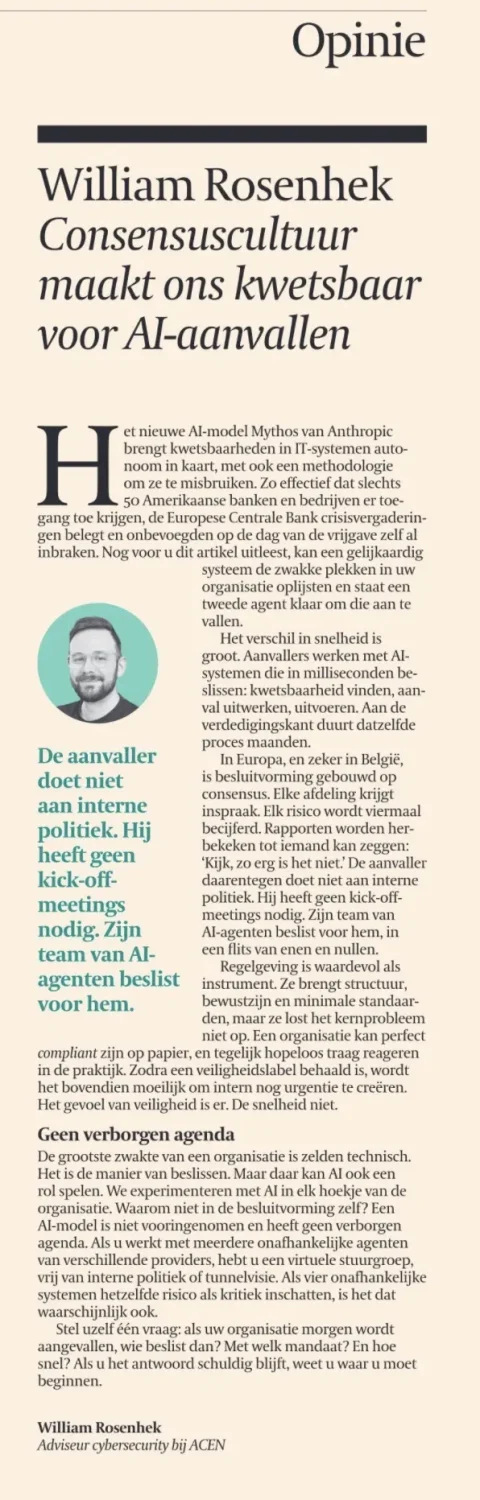
Consensus culture makes us vulnerable to AI attacks
Anthropic’s new AI model Mythos maps vulnerabilities in IT systems on its own, and comes with a method for exploiting them. It is so effective that only 50 American banks and companies are getting access to it, the European Central Bank is calling crisis meetings, and unauthorised parties broke in on the very day it was released. Before you finish reading this article, a similar system could list the weak spots in your organisation, with a second agent ready to attack them.
The gap in speed is large. Attackers work with AI systems that make decisions in milliseconds: find the vulnerability, work out the attack, carry it out. On the defending side, the same process takes months.
In Europe, and certainly in Belgium, decision-making is built on consensus. Every department gets a say. Every risk is calculated four times over. Reports get reviewed until someone can say: “Look, it’s not that bad.” The attacker, on the other hand, doesn’t do internal politics. He doesn’t need kick-off meetings. His team of AI agents decides for him, in a flash of ones and zeros.
Regulation is valuable as a tool. It brings structure, awareness and minimum standards, but it doesn’t solve the core problem. An organisation can be fully compliant on paper and still respond hopelessly slowly in practice. And once a security label has been earned, it becomes hard to create any sense of urgency internally. The feeling of security is there. The speed isn’t.
“The attacker doesn’t do internal politics. He doesn’t need kick-off meetings. His team of AI agents decides for him.”
No hidden agenda
An organisation’s biggest weakness is rarely technical. It’s the way it makes decisions. But AI can play a role there too. We’re experimenting with AI in every corner of the organisation. Why not in decision-making itself? An AI model isn’t biased and has no hidden agenda. If you work with several independent agents from different providers, you have a virtual steering committee, free of internal politics or tunnel vision. If four independent systems rate the same risk as critical, it probably is.
Ask yourself one question: if your organisation is attacked tomorrow, who decides? With what mandate? And how fast? If you can’t answer, you know where to start.